As northern Nevada’s only not-for-profit academic health system, Renown relies on the generosity of donors to save lives, nurture minds and provide exceptional care for all people. Because of the essential role of philanthropy at Renown Health, Renown Health Foundation offers many opportunities to learn more about estate and charitable gift planning.
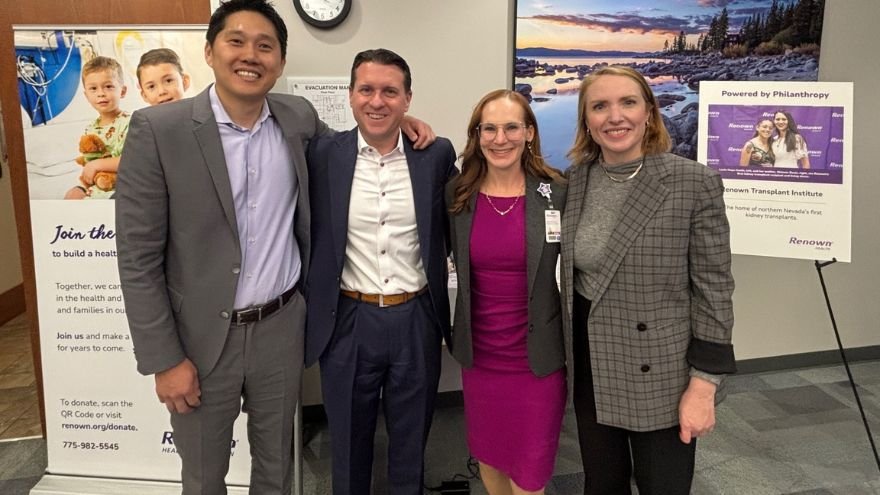
With significant tax changes in 2026, the Foundation recently invited guest speakers Katelyn Wheeler and Jeff Ruderman of Capital Group Client Private Services to provide actionable insights on charitable giving strategies and the new tax landscape. Both Katelyn and Jeff have extensive experience helping clients with charitable, tax, and estate planning; Jeff drawing on his background in finance and Katelyn drawing on hers in the law.
Our conversation with Katelyn and Jeff was engaging and insightful. We’ve included highlights below for the benefit of those who could not attend or are simply interested in the subject-matter. Links to additional planning resources at Renown can also be found below.
Questions to ask yourself when considering a charitable gift
There are several questions an individual may want to ask themself when considering a charitable gift to Renown or any other public charity, including:
- How much can I give?
- What type of assets can I give?
- When should I give?
- Should I use a charitable giving strategy or structure?
Professional advisors can help guide you through these considerations to help you determine how to make the greatest impact with your charitable giving in a way that fits your assets, timeline, values, and desires.
Potential impact of the new tax law on charitable giving
Five primary policy changes in the One Big Beautiful Bill (OB3), which became effective on January 1, 2026, will likely shape philanthropy in the coming years:
1. Elevated Standard Deduction Permanent beyond 2025
Prior to the Tax Cuts and Jobs Act (TCJA), the standard deduction was $6,500 for individual filers and $13,000 for joint returns. In 2018, when the TCJA became effective, the standard deduction nearly doubled to $12,000 for individual filers and $24,400 for joint returns. With the passing of OB3, those elevated deductions are now permanent beyond 2025. In 2026, the inflation-adjusted standard deduction is $16,100 for individual filers and $32,200 for joint filers.
Impact: The historically high standard deduction is significant because it vastly decreases the portion of taxpayers who itemize. Donors may change their giving strategies to get above the standard deduction in select years to maximize their charitable giving deduction beyond the Universal Charitable Deduction (see below).
2. Universal Charitable Deduction (UCD)
Non-itemizers can deduct up to $1,000 in cash gifts ($2,000 for joint filers) to qualified public charities (that is, not to Donor Advised Funds or Private Foundations).
Impact: The new UCD may increase the number of taxpayers making charitable gifts and small to moderate-sized gifts.
3. 0.5% Adjusted Gross Income Floor for Itemizers
Taxpayers who itemize may only deduct charitable gifts above 0.5% of AGI.
Impact: This tax change could reduce giving among itemizing households because charitably inclined taxpayers will need to exceed the 0.5% AGI floor before their donations become deductible.
4. 35% Deduction Cap for Itemizers
For taxpayers in the 37% tax bracket, the value of the charitable deduction is now capped at 35%. Stated another way, instead of a 37-cent tax benefit per dollar of donation, that benefit is now limited to 35 cents per dollar.
Impact: This tax change could reduce giving among taxpayers in the highest tax bracket by decreasing the tax incentive to make a charitable gift.
5. 1% Taxable Income Floor for Corporations
Corporations must give above 1% of taxable income before they may deduct charitable gifts.
Impact: This tax change could reduce corporate giving below the 1% floor.
Structuring your charitable giving under the current tax landscape
While the above tax changes are likely to have some impact on charitable giving, many donors are motivated to give for reasons far beyond the tax benefits of their donations.
In Renown’s case, many donors give because they want great healthcare close to home, and their donations ensure local access to high-quality lifesaving care, fund medical technology, support pediatric care, and aid in the training of skilled nurses in our region. Learn more about how donations empower healthcare here.
Taking into consideration the above tax changes, Katelyn and Jeff discussed how giving strategies may help charitably minded individuals and entities maximize the tax benefits of their giving:
- “Bunch” gifts in key tax years – donors may want to combine multiple years of charitable gifts into a single tax year and itemize deductions in that year to increase tax savings. In non- “bunch” years, those donors could claim the standard deduction.
- Give using a qualified charitable distribution from an Individual Retirement Account (also referred to as a rollover IRA) – donors age 70.5 and up may make qualified charitable distributions from their IRA, avoiding income tax on the future distribution or their required minimum distribution if over the age of 73.
- Give appreciated non-cash assets such as publicly traded stock – by donating appreciated assets such as publicly traded stock, donors may avoid capital gain on the sale of those assets. If the fair market value of the appreciated asset, in combination with any other deductions the donor is eligible for, exceeds the standard deduction, the donor may also itemize the year of the gift to maximize their charitable gift tax deduction.
- Establish or donate from a Donor Advised Fund (DAF) – A DAF is essentially a charitable savings or investment account. Technically, it is a tax-advantaged, dedicated account held and managed at a public charity known as a sponsoring organization. DAFs allow donors to contribute cash or assets for an immediate tax deduction, invest for potential tax-free growth, and recommend grants to qualified nonprofits over time.
Donors with an existing DAF may recommend grants to their charities of choice without any personal income tax implications. DAFs can also be a useful tool for taxpayers that may have an upcoming liquidity event, are looking to bunch and perhaps not yet ready to decide on where those funds should be given, or donors interested in an easier-to-manage alternative to a private foundation for long-term family philanthropy.
One of the most significant tax-planning tools OB3 did not impact but that Jeff and Katelyn also spoke to is the importance of timing your charitable gifts, which can greatly impact tax savings. As always, make sure you lean on trusted advisors to help guide these significant decisions.
Thank you, Jeff and Katelyn, for sharing your time and expertise with us and educating us on how to give in tax-beneficial and especially impactful ways. Renown Health is incredibly grateful for your dedication to providing this important and useful information to our community.
Click on the links below to learn more about the many ways to give to Renown, access our free estate planning resources, and to sign up for a Community Estate Planning & Advance Health Care Directive Workshop. Planned giving officer, Abbey Stephenson, is also available at abbey.stephenson@renown.org to answer your questions and provide additional information.
The information provided above does not and is not intended to constitute legal or tax advice; instead, all information is for general informational purposes only. This information may not constitute the most up-to-date legal or other information. You should contact your attorney or tax consultant to obtain advice with respect to any particular legal or tax matter. You should not act or refrain from acting on the basis of information herein without first seeking legal advice from counsel in the relevant jurisdiction. Only your individual attorney or tax consultant can provide assurances that the information contained herein- and your interpretation of it- is applicable or appropriate to your particular situation. All liability with respect to actions taken or not taken based on the information herein are hereby expressly disclaimed. This content is provided “as is;” no representations are made that the context is error-free.