
Stroke Treatments and Outcomes

Stroke Types and Treatment Approach
We treat different types of stroke and track outcomes to ensure safe, effective care. Our coordinated stroke team includes, neurologists, emergency physicians, nurses, therapists and specialists work together from the moment you arrive.
Below is an overview of how strokes are classified and what treatment methods our team provides.
Understanding the Two Main Types of Stroke
Treatment depends on whether a stroke is caused by a blocked blood vessel or bleeding in the brain.
1️⃣ Ischemic Stroke (Blocked Blood Vessel)
Clot-busting medication may be given to dissolve the blockage. In some cases, specialists at our Comprehensive Stroke Center perform minimally invasive procedures to remove the clot.
2️⃣ Hemorrhagic Stroke (Bleeding in the Brain)
Our team works quickly to control bleeding and reduce pressure in the brain. Neurosurgical care is available at Renown Regional when needed.
Services
Stroke survivors require additional treatment and rehabilitative therapies to prevent future strokes. The Renown Neurovascular and Stroke Program offers many different treatments to minimize reoccurrence and optimize chances for functional recovery.
Ask your primary care provider for a referral, or call 775-982-5000 for more information.
These programs include:
- Diagnostics tools including MRI, CT angiography, catheter angiography, echocardiography, and long-term cardiac monitoring.
- Surgical treatments including: carotid artery stenting, intracranial percutaneous angioplasty, intracranial stenting, carotid endarterectomy.
- Consultations with physical therapy, occupational therapy, speech and language therapy and physiatry.
- Comprehensive evaluation by a Stroke specialist to initiate medications to prevent future strokes.
When a stroke occurs, it is a medical emergency where minutes matter. At Renown Regional, a Code Stroke team responds 24 hours per day, 365 days a year. During a Code Stroke, a series of evaluations and stroke treatment occur, including:
- Activation of the Stroke team by first responders before hospital arrival.
- Immediate assessment on hospital arrival by a stroke neurologist.
- Expedited advanced neuroimaging to determine if brain tissue can be saved.
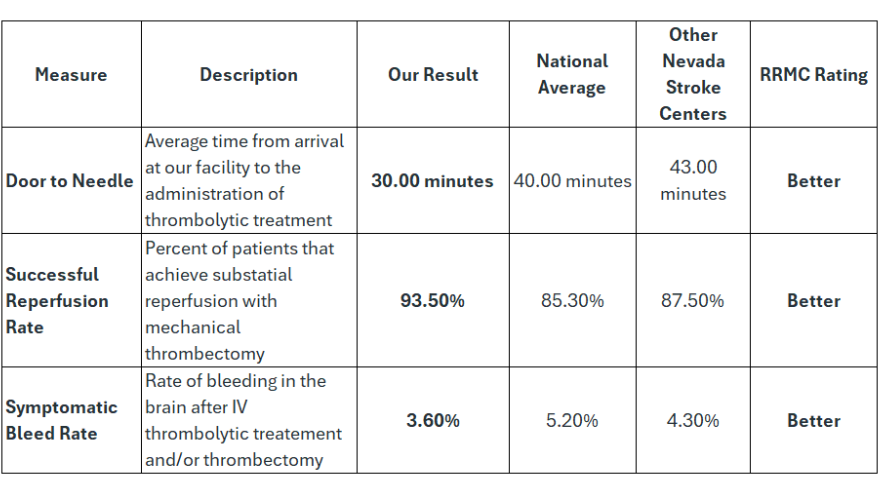
- Initiation of acute stroke treatment within tens of minutes of patient arrival. This can include the administration of a clot-busting medication (thrombolytics) and/or the surgical removal of the blood clot by neurointerventional surgery (surgery completed via blood vessels).
Treatment depends on the type and severity of stroke.
Ischemic Stroke Treatment
- IV clot-dissolving medication (for eligible patients)
- Mechanical thrombectomy at Renown Regional
Hemorrhagic Stroke Management
- Multidisciplinary medical management
- Neurosurgical evaluation and intervention when required
Multidisciplinary Stroke Team
- Neurologists
- Neurosurgeons
- Critical care specialists
- Internal medicine physicians
- Specialized stroke nurses
- Pharmacists
- Rehabilitation therapists
Recovery begins in the hospital and continues long after discharge.
Inpatient and Early Rehabilitation:
- Physical therapy
- Occupational therapy
- Speech and swallow therapy
- Early mobility and strength training
- Cognitive and language evaluation
Discharge & Ongoing Support:
- Daily interdisciplinary care planning
- Stroke prevention and risk factor education
- Post-hospital follow-up call
- Neurovascular Clinic follow-up (Comprehensive Stroke Center)
- Community resources and support groups
In addition to the care provided to stroke patients, Renown Neurovascular and Stroke Program provides care to patients with other neurovascular diseases:
- Aneurysm coiling: An aneurysm is a weakening in the blood vessel wall. Renown Neurointerventional surgeons place coils and/or stents to re-strengthen the blood vessel wall to prevent future brain bleeding.
- Carotid Artery Occlusion Procedures: Carotid artery stenting and angioplasty completed as a minimally invasive procedures by Northern Nevada's only Neurointerventional Radiologists. Carotid endarterectomy performed by Renown’s Vascular surgeons.
- Hemorrhagic strokes: These strokes result from brain bleeding, and patients may have life-threatening complications related to brain swelling, which is treated by neurosurgery.
- Vascular malformations: Some hemorrhagic strokes are caused by an underlying abnormality in the blood vessels. Examples are arteriovenous malformations or dural arteriovenous fistulas. Treatments for vascular malformations require a multidisciplinary approach of Neurology, Neurosurgery, and Neurointerventional Surgery available at Renown Regional Medical Center.